
Guest Post: What I Learned About Patient Advocacy Attending ASCO and ESMO
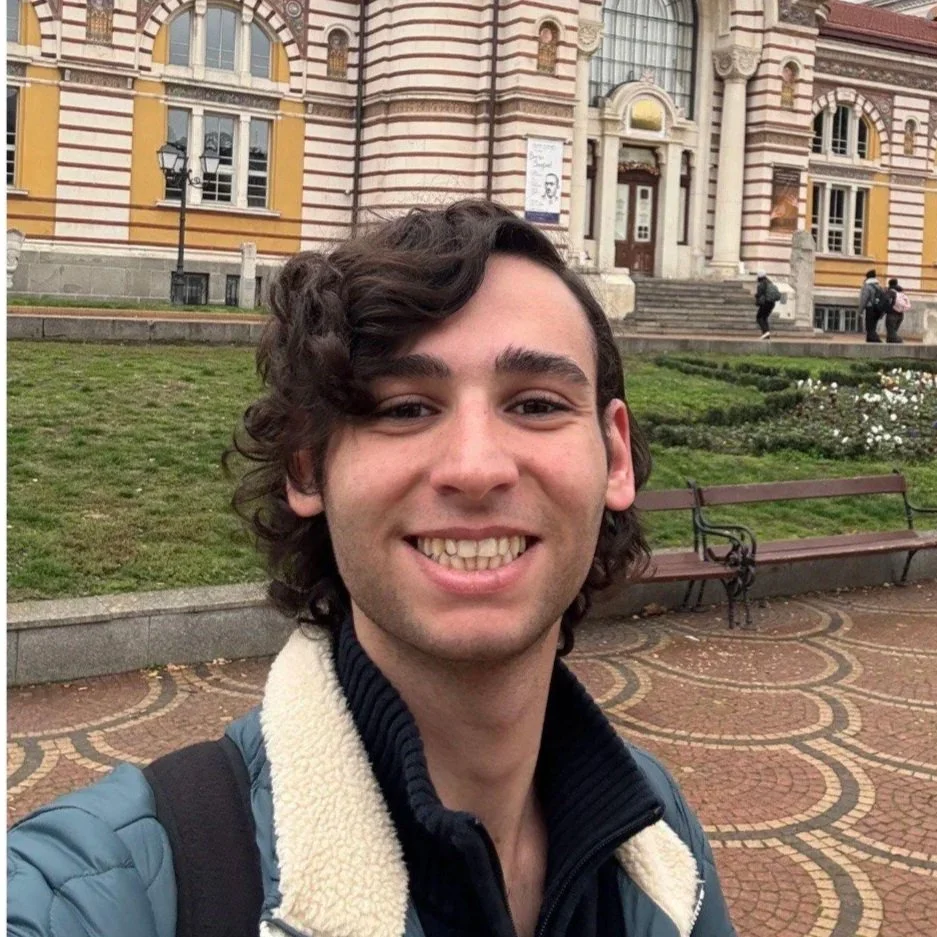
About the author:
Max Penzer is an osteosacroma survivor from Long Island, NY, and is approximately ten years NED (No Evidence of Disease). Currently, he is a third-year pre-med student at Tufts University.
Max was awarded a 2025 Children’s Cancer Cause college scholarship in recognition of his passion for patient advocacy on behalf of children with cancer.
All views expressed are the author’s own.
Last year, I had the opportunity to attend both the American Society of Clinical Oncology (ASCO) Annual Meeting in June in Chicago, and the European Society of Medical Oncology (ESMO) Annual Congress in October in Berlin, on the patient advocate track.
Attending these two conferences provided me with unique opportunities to observe how patient advocacy is conceptualized and practiced on both sides of the Atlantic. While both meetings formally recognize the importance of incorporating patient voices into oncology, the way advocacy is structured, supported, and operationalized reveals meaningful differences in priorities, culture, and healthcare structures.
At ASCO, patient advocacy felt decentralized and individual-centered. The advocacy-facing sessions largely emphasized skill-building, such as developing one’s voice as a patient advocate, telling one’s story effectively, and bringing new tools and perspectives back to your nonprofit organization. The underlying assumption seemed to be that advocacy work is carried out through many independent organizations and individuals, each responsible for representing their own populations within the broader oncology ecosystem.
Several advocacy not-for-profit organizations had booths in the ASCO expo hall, reinforcing the feeling that advocacy groups are stakeholders alongside pharma, biotech, and academic institutions. Further, at the ASCO annual meeting, the patient advocacy track consisted of three Q&A panel sessions held in the patient advocacy lounge. These sessions focused on empowering your nonprofit to expand its reach. Only the patient advocates attended these sessions (~20-30 participants), making them relatively small and close-knit.
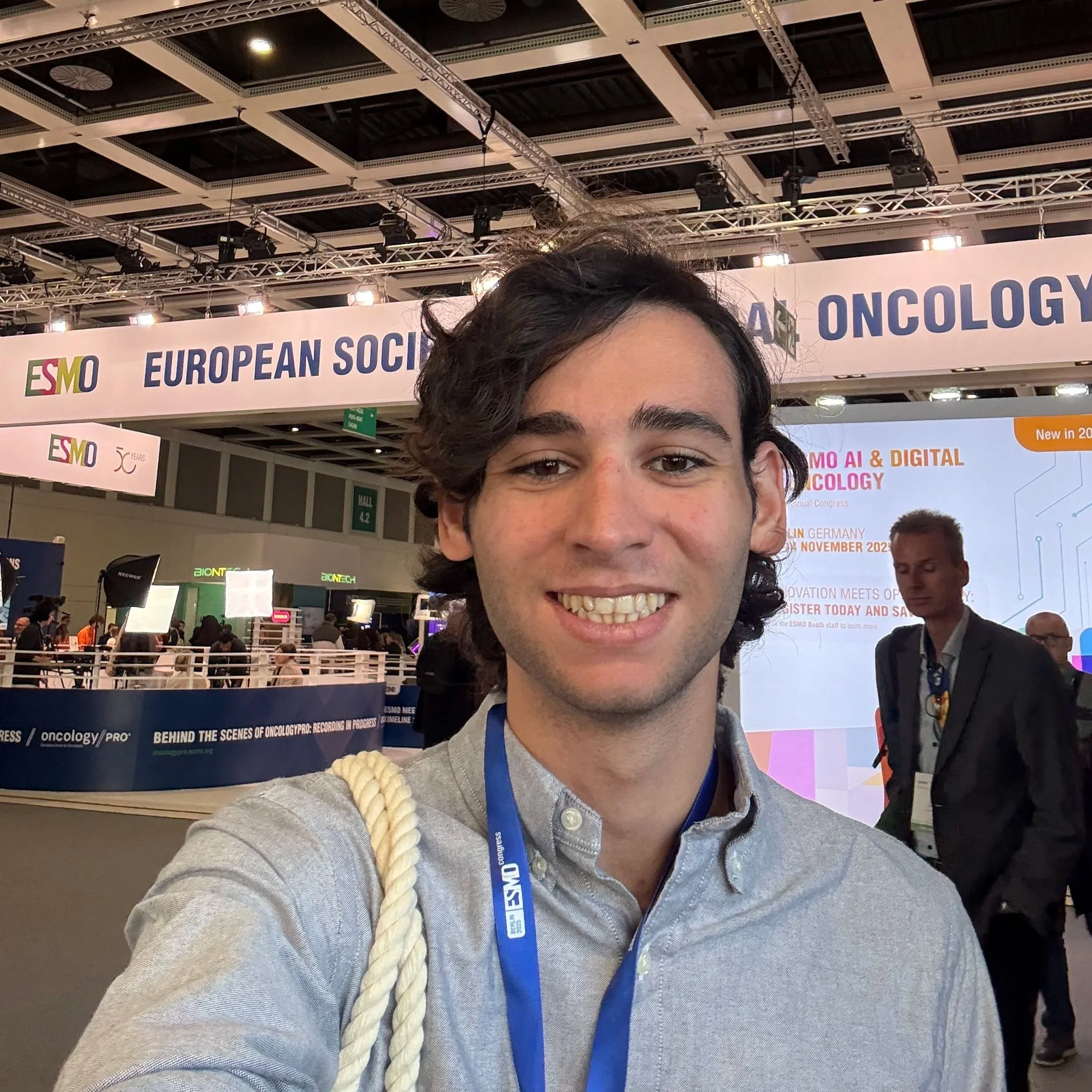
Pictured: Max at ESMO in Berlin, 2025
Constrastingly, patient advocacy at ESMO felt far more centralized and institutionalized. Rather than focusing on individual skill development, ESMO emphasized its Patient Advocacy Working Group as a collective body designed to coordinate advocacy efforts and drive political and structural change. Advocacy sessions were issue-specific rather than personal, aiming to integrate patient perspectives into defined areas such as artificial intelligence, fertility, quality assurance, and diversity, equity, inclusion, and justice (DEIJ).
The ESMO patient advocacy track consisted of four sessions that were much more structured than the ASCO sessions. These sessions were formatted similarly to a standard scientific oral abstract session: brief presentations followed by a short Q&A. Additionally, these sessions were attended by ~300-400 participants, including oncologists, surgeons, pharma representatives, and others, not only the patient advocates.
One of the most striking advocacy discussions at ESMO centered on oncofertility and quality of life — topics that did not have a strong focus at ASCO, which centered mostly on healthcare policy. Speakers emphasized that oncologists have a responsibility not only to treat cancer, but to address life during and after cancer, including fertility, body image, and self-confidence. Oncofertility was framed not merely as fertility preservation but as encompassing prevention of fertility impairment, access to assisted reproduction, and shared decision-making tools.
Yet major gaps remain: reimbursement for oncofertility care is inconsistent across the EU, and even where reimbursement exists, data show it has not meaningfully increased access. These conversations underscored another key difference between ASCO and ESMO: the role of advocacy in shaping clinical responsibility. At ESMO, there was a strong emphasis on the physician’s duty to initiate conversations about quality of life, fertility, and long-term side effects, particularly in the context of targeted therapies, immunotherapies, and radiotherapy, where gonadotoxic risks remain under-researched. This constrasted with the more patient-driven advocacy model at ASCO, where patients are often encouraged to advocate for themselves in clinical encounters.
Ultimately, neither model is inherently superior. While the U.S. community could learn from Europe’s ability to unify advocacy efforts into coordinated, policy-driven action, the European oncology community could benefit from the U.S.’s emphasis on population-specific advocacy where dedicated tracks and communities for groups such as pediatric, adolescent and young adult, or breast cancer patients ensure that distinct clinical and psychosocial needs are not diluted within broader oncology discussions.
Experiencing both conferences showed me that effective patient advocacy likely requires a balance between individual voices strong enough to be heard and collective structures capable of translating those voices into lasting change.