
Our 2025 Year in Review ✨
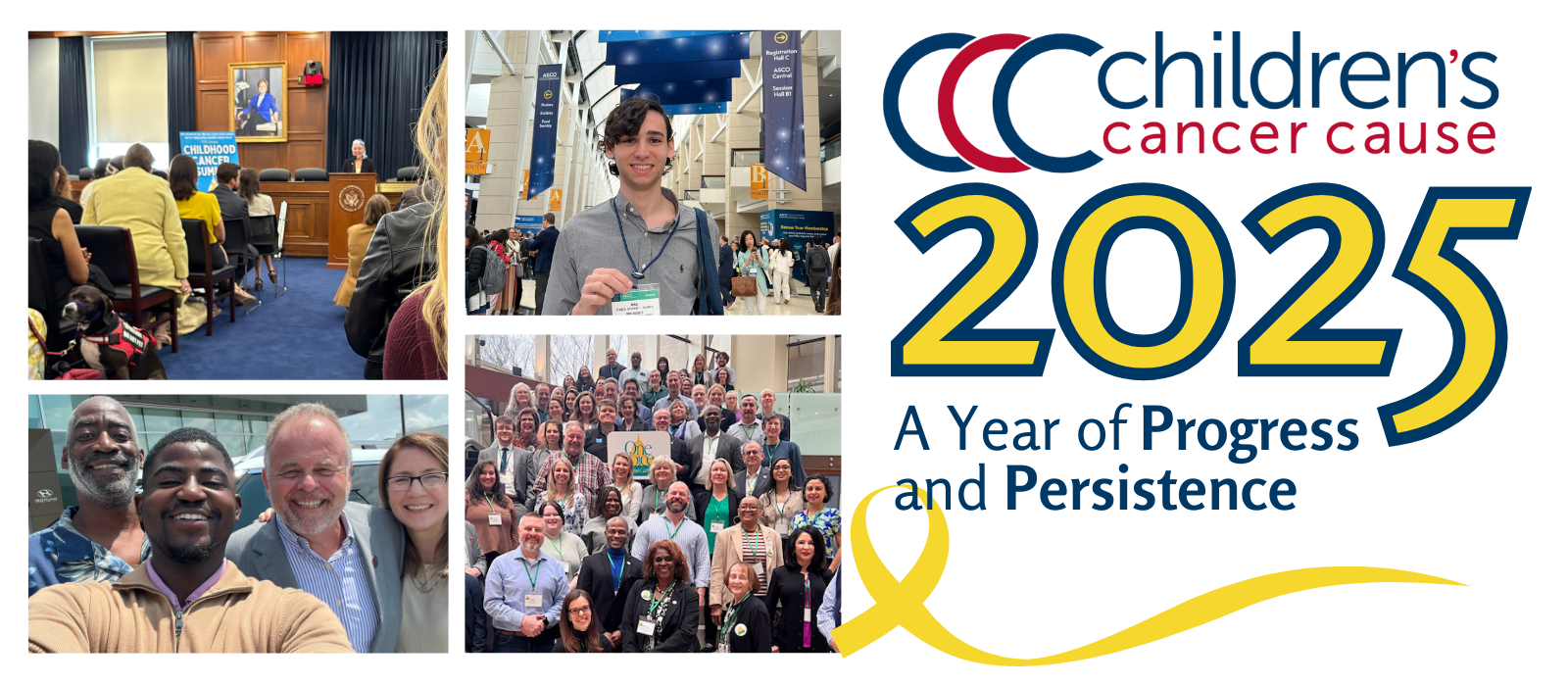
In 2025, Children’s Cancer Cause made meaningful strides toward our vision of a future where every child with cancer has the support and care they need to survive and thrive. From expanding survivorship programs to defending and advancing critical research and health policy, 2025 was marked by both hard-won progress and tireless determination.
While we celebrated important victories this year, the childhood cancer community also encountered some of the biggest challenges we have ever faced.
With you in our corner, we met those challenges head-on.
Investing in Survivorship by Expanding Programs and Resources
Survivorship is at the heart of our mission, and in 2025 we deepened our commitment to young people navigating life after childhood cancer.
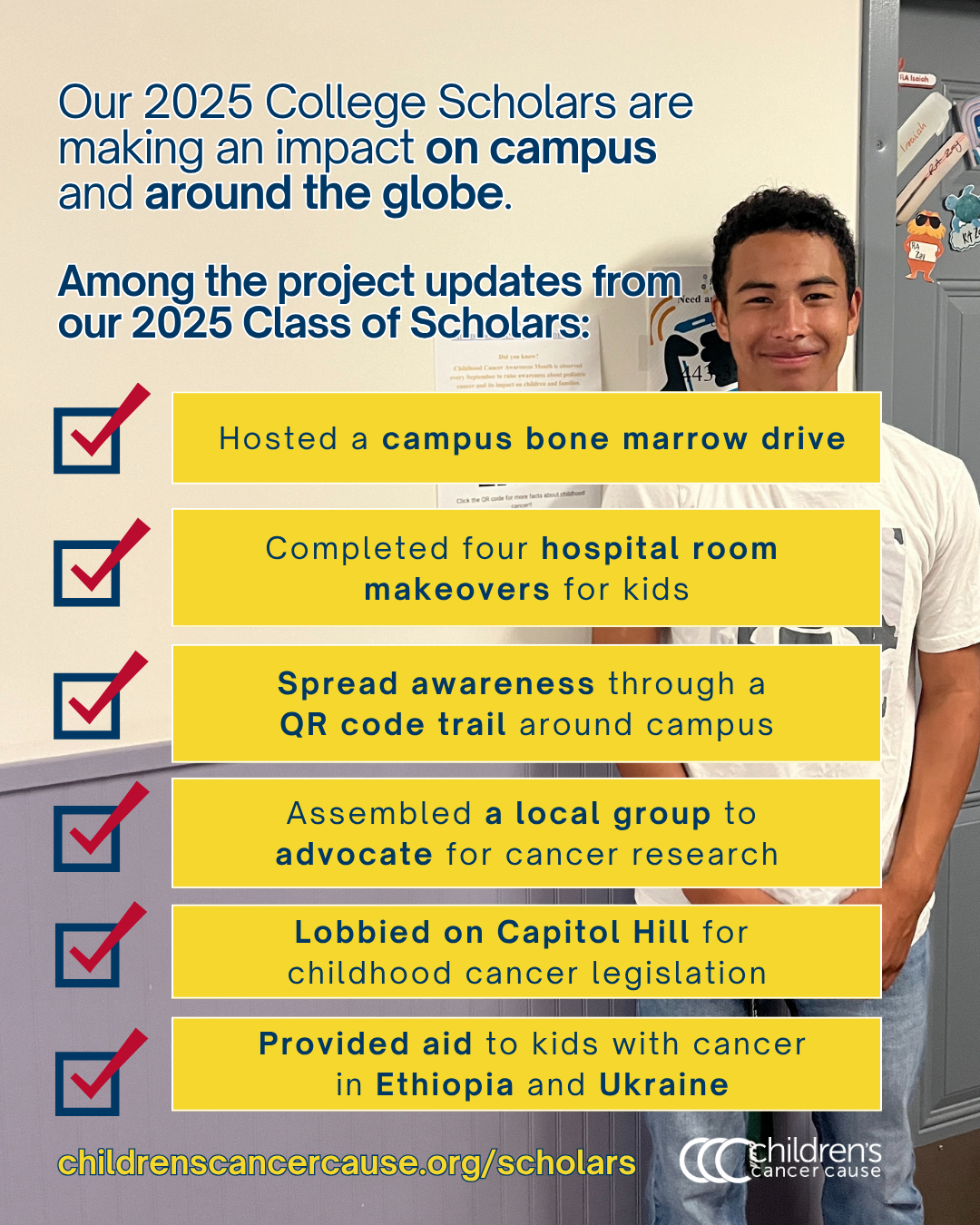
Thanks to a generous survivorship program grant from Hyundai Hope On Wheels, Children’s Cancer Cause awarded a record number of academic scholarships to childhood cancer survivors in 2025. The twenty-two survivors welcomed into our College Scholars Program this year have each committed to a volunteer project related to cancer advocacy. Several projects have been successfully completed, including a campus bone marrow drive, the formation of a community advocacy group, and support for children with cancer in Ethiopia.
We also made major strides in expanding access to survivorship education. This year, we added new content to our Stewart Initiative for Childhood Cancer Survivors educational site and turned it into a bilingual resource, allowing Spanish-speaking survivors to engage with our mobile-friendly courses. Designed for childhood cancer patients and survivors ages 15–30, the modules address critical topics such as survivorship care plans, late effects, disability rights, insurance access, and finances.
This work is resonating. Survivors are visiting our Stewart site in record numbers — evidence that these young people are actively seeking credible, accessible information to support their long-term health.
Listening to survivors remains central to our approach. Each year, we invite teens, young adults, and adult survivors to participate in our Summer Survey, which highlights persistent challenges facing the nation’s 521,000 survivors of childhood cancer.
Our 2025 survey revealed deep frustration among survivors related to barriers to quality care, gaps in provider knowledge, and a perceived lack of support from policymakers. These findings continue to inform both our programs and our advocacy priorities.
To help strengthen survivorship care nationwide, we launched the Survivorship Program Resource Center in 2025. This new hub highlights U.S. survivorship programs recognized in recent years for excellence through the Children’s Cancer Cause Survivorship Champion’s Prize.
The Resource Center serves as a practical guide for institutions seeking to build, expand, or improve survivorship care models -- helping ensure survivors receive lifelong, high-quality follow-up care no matter where they live.
Defending Progress and Driving Policy Forward
Alongside our programmatic work, 2025 was a year of intense advocacy and policy engagement.
Just this month we celebrated a major legislative milestone: the House of Representatives unanimously passed the Mikaela Naylon Give Kids a Chance Act! This bipartisan bill is the most comprehensive childhood cancer legislation in more than a decade. While this victory represents meaningful progress, the work is not finished.
Congress has recessed for 2025. We will continue pressing for this bill in the Senate when Congress reconvenes in 2026.
This milestone represents the culmination of a year of intentional advocacy efforts that began early with education, mobilization, and direct engagement with policymakers. We kicked off the year with an interactive policy webinar, equipping advocates to navigate a rapidly changing landscape with the start of a new Congress and Administration.
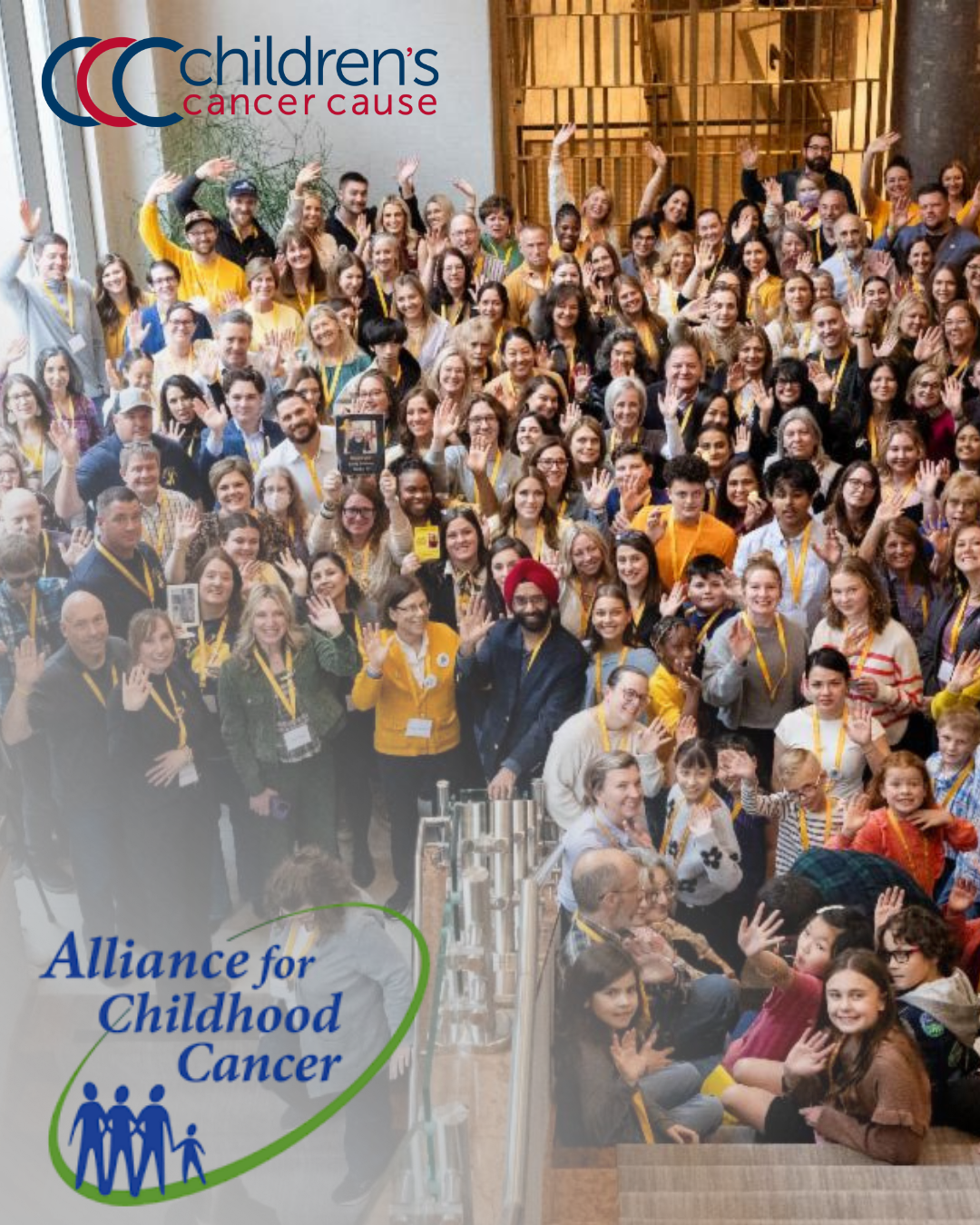
Throughout the year, we also participated in and mobilized advocates for multiple Capitol Hill lobby days, bringing childhood cancer families face to face with lawmakers and reinforcing the human impact of policy decisions.
The engagement and mobilization of our grassroots network further proved essential this year as cancer research funding came under serious threat. In March, the White House proposed an unprecedented $18 billion cut to the National Institutes of Health (NIH) and proposed eliminating cancer prevention efforts at the Centers for Disease Control and Prevention (CDC). These proposals followed dramatic cuts and terminations at the CDC, FDA, and NIH due to a sweeping restructuring of the Department of Health and Human Services.
In response, we spent much of 2025 pushing back against these harmful cuts, rallying bipartisan Congressional support for medical research funding and underscoring what is at stake for children with cancer and survivors alike.
The combined efforts of the medical research community made a real difference. At the committee level in both the House and Senate appropriations processes, lawmakers have supported slight increases to NIH funding, reflecting continued bipartisan recognition of the importance of research — even as budget stalemates and the longest government shutdown in history have delayed passage of a full-year FY26 budget.
Expert Guidance in Uncertain Times
In the context of this challenging advocacy environment, our expert advisors and our coalition work is especially critical.
“Advocacy has become more important than ever for our patients and our families,” said Dr. Michael Link upon accepting our 10th annual Leonard M. Rosen Memorial Research Award in November.
“In our current environment, there are multiple challenges facing us. Devastating cuts to research, a less predictable regulatory environment, and an assault on science with head-spinning consequences.”

“I’m grateful to Children’s Cause for all the education and support they have provided for me and continue to provide,” said Dr. Link, a longtime board member of Children’s Cancer Cause, chair of the organization’s Policy Committee, and co-chair of the Alliance for Childhood Cancer.
Established in 2016, the Children’s Cancer Cause Rosen Award highlights individuals whose advocacy and groundbreaking work has advanced the care and treatment of children with cancer, the leading cause of death by disease among children in the United States.
Dr. Link joins an esteemed group of Rosen Award recipients recognized for advocating for childhood cancer patients as researchers in healthcare, economics of drug development, outcomes research, enhanced access to drugs, and survivorship.