
AACR Releases Inaugural Pediatric Cancer Progress Report

The American Association for Cancer Research (AACR) released the first, comprehensive Pediatric Cancer Progress Report 2025, capturing both the extraordinary progress made in treating childhood cancer and the urgent challenges that remain.
We’re proud to share that our founder Susan Weiner, PhD, was the only childhood cancer patient advocate on the 31 member steering committee that reviewed and edited the report. The report is a thorough review of decades of progress in pediatric cancer research, treatment, and survivorship.
“We are deeply grateful to the steering committee for its extraordinary leadership in bringing this important report to fruition, as it will serve as an essential resource for those in the medical research and policy communities who are dedicated to improving pediatric cancer prevention, diagnosis, treatment, and survivorship,” said Margaret Foti, PhD, MD (hc), chief executive officer of AACR.
The inaugural AACR Pediatric Cancer Progress Report 2025 highlights how research is transforming outcomes for children and adolescents, from molecularly targeted therapies and immunotherapies to genomic profiling that informs surveillance and treatment decisions. This first-of-its-kind report also underscores the gaps in our knowledge of pediatric cancers that are rare compared to most adult cancers, and are often understudied. It emphasizes the urgent need for increased federal investments, international collaborations, and innovative approaches to address these challenges.
Celebrating Progress: “Decades of research and collaborations have transformed the outlook for cancers affecting children and adolescents.”
The report underscores how scientific inquiry, collaboration, advocacy, and policy action have dramatically improved outcomes for children and adolescents with cancer.
Among the encouraging trends:
Survival has significantly improved. In the United States, the five-year survival rate for all pediatric cancers combined has increased from 63% in the mid-1970s to 87% in 2015-2021. As of 2022, more than 521,000 pediatric cancer survivors were living in the United States, a number projected to exceed 580,000 by 2040.
Mortality continues to decline. Pediatric cancer mortality in the United States declined by 57% between 1970 and 2000, and by a further 19% from 2001 to 2023, reflecting advances in therapy, precision medicine, and supportive care.
Scientific understanding has grown exponentially. Research has revealed that pediatric cancers are fundamentally different from adult cancers, with unique biological drivers and therapeutic vulnerabilities. Precision medicine is enabling clinicians to tailor treatment to the individual patient, and technologies such as gene editing, liquid biopsy, and AI are paving the way for additional breakthroughs.
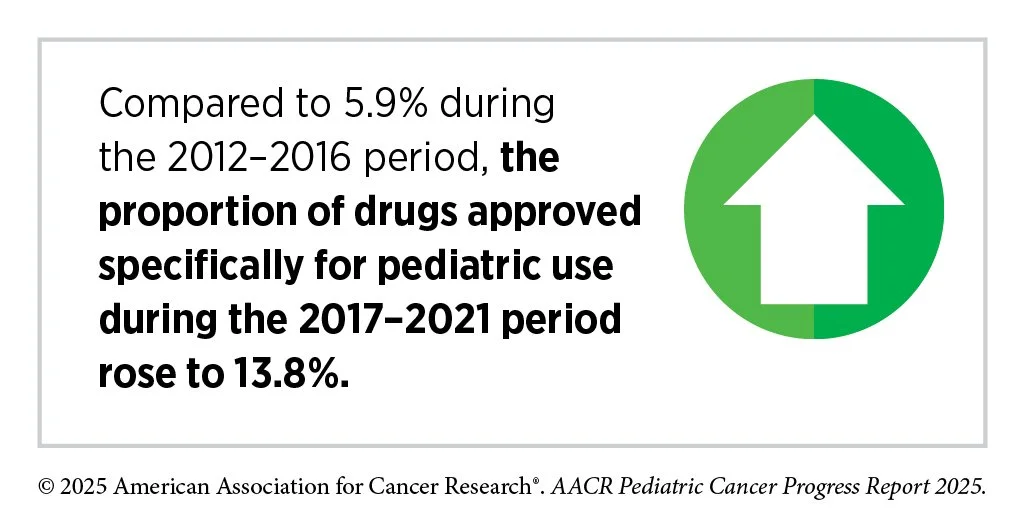
New treatments are reaching children faster. Since 2015, the FDA has approved more than 20 molecularly targeted therapies and more than 10 immunotherapies for pediatric cancers. While approvals still lag behind adult cancer therapies, these breakthroughs have been life-changing for many young patients.
Collaborative efforts are expanding globally. International partnerships are facilitating innovative ways to collaborate such as sharing molecular profiling data and improving access to care in low-resource settings.
Significant Challenges & Uneven Progress: “The burden of pediatric cancer remains high.”
In 2025 alone, nearly 15,000 children and adolescents in the U.S. are expected to be diagnosed with cancer, and almost 1,700 will lose their lives.
Survivorship Challenges
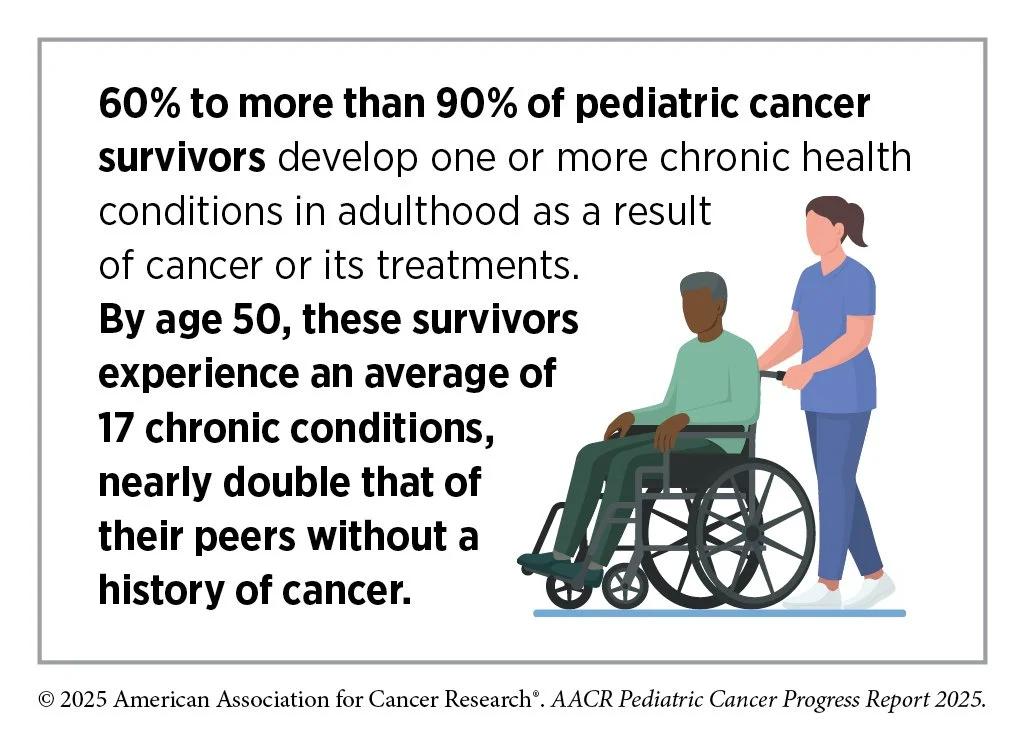
By age 50, survivors experience nearly twice as many chronic conditions as their peers without a history of cancer. Survivorship challenges also extend beyond physical health, with increased risks of anxiety, depression, PTSD, and financial hardship.
The report highlights the multidimensional, long-lasting challenges faced by survivors and underscores the importance of robust survivorship support systems, including accessible health insurance, mental health services, and socioeconomic assistance.
Research Challenges
Because pediatric cancers are rare, clinical trials have fewer participants than adult trials, and pharmaceutical incentives are limited.
The pace of progress has slowed compared to adult cancers, making federal funding, data sharing, and international collaborations more crucial than ever.
In addition, there are known disparities and inequalities within pediatric cancer:
While five-year survival rates in the U.S. exceed 90% for cancers such as Hodgkin lymphoma, thyroid cancer, and retinoblastoma, other aggressive cancers including certain gliomas and sarcomas still have survival rates below 25%.
Hispanic children experience the highest cancer incidence rates.
Non-Hispanic Black children are nearly 30% more likely to die from certain pediatric cancers than non-Hispanic White children.
Children in rural or economically disadvantaged areas face greater barriers to specialized care, clinical trials, and supportive services.
Worldwide, approximately 400,000 children develop cancer each year, and up to 90% of cases occur in low- and middle-income countries where survival rates are far lower due to underdiagnosis, limited treatment resources, and delays in care. For example, retinoblastoma survival approaches 98% in high-income countries but can fall to 57% in low-income countries.
Advocacy Matters:
“Decisions made today by Congress and the federal government will shape the fight against pediatric cancer for decades to come.”
“Past investments, support, and legislative actions from the US government have played a crucial role in accelerating progress against pediatric cancer,” the report states. “Bipartisan congressional efforts in both the House and Senate, including champions within the Congressional Childhood Cancer Caucus, have been key to many of the past decade’s achievements, especially in expanding pediatric cancer data collection, building research infrastructure, and accelerating drug development.”
Key legislative victories from recent years include the Creating Hope Act, the RACE for Children Act, the Gabriella Miller Kids First Research Act, the Childhood Cancer STAR Act (and the subsequent STAR Reauthorization Act), and the Childhood Cancer Data Initiative.
“These legislative and policy achievements, the result of extensive coordination between advocacy groups, health professionals, and policymakers, continue to make significant, tangible steps forward in pediatric cancer research and help accelerate the development of new and more effective treatments,” the authors write.
Rep. Michael McCaul, co-chair of the Congressional Childhood Cancer Caucus, speaking at the report’s release on Capitol Hill (12.4.25)
What’s next? Among the specific pieces of pending legislation mentioned in the report is the Innovation in Pediatric Drugs Act, which would make needed improvements to the Best Pharmaceuticals for Children Act (BPCA) and the Pediatric Research Equity Act (PREA) and builds upon the promise of the Research To Accelerate Cures and Equity (RACE) Act. This legislation is included in the House-passed version of the Mikaela Naylon Give Kids a Chance Act, a comprehensive bill that also incentivizes critical pediatric research by expanding the FDA priority review voucher program and helps address the need for timely studies of drug combinations in children. Please join us in asking your Senators to cosponsor and pass this critical bipartisan legislation so it can reach the president’s desk and become law.
The report also recommends the Accelerating Kids’ Access to Care Act, which would create a pathway for pediatric providers to enroll in multiple state Medicaid programs, reducing overall administrative burden, bureaucratic hurdles, and therefore delays in accessing specialized care for children with cancer. Join us in asking Congress to pass this bipartisan legislation so that Medicaid and CHIP-enrolled children can get the necessary care they need without delay, no matter where they live.
Children’s Cancer Cause is pleased that the report also includes mention of the Comprehensive Cancer Survivorship Act (CCSA), legislation that we have championed in recent years, working closely with Hill staff to ensure that pediatric cancer survivor provisions are included. We continue to work to secure reintroduction of the bill in this Congress.
As the report notes, the CCSA “would provide coverage for care-planning to address the transition from oncology to primary care, develop helpful patient navigation for survivorship services, establish employment assistance grants, increase education on survivorship needs, ensure coverage for fertility preservation services, and examine existing payment models and ways they can be improved. The CCSA aims to address known gaps in survivorship care for pediatric cancer patients and will also require additional research on the long-term and late effects of cancer diagnosis and treatment in these populations.”

“Now is the time to come together.”
Children’s Cancer Cause thanks AACR for this landmark report, and we join in their call to action for stakeholders and policymakers to come together in advancing the progress that has been made and sustaining it for future generations.